Researchers at Memorial University of Newfoundland are looking for the opinions of municipal planners in Atlantic Canada on climate change adaptation, and potential actions, benefits, and barriers. Click here to complete the survey.
Equity Strategy for Municipal Climate Action Planning
Published by: David Suzuki Foundation
Authored by: Nya Lazarus-Munnick, Nicola Radatus-Smith, Theresa Nguyen
Empowering change within communities can be a challenge when you don’t know where to start.
The “Equity Strategy for Municipal Climate Action Plan” presents a comprehensive strategy for municipalities to integrate equity into their Climate Action Plans. A notable finding is that most Canadian CAPs lack an equity component, and when it is included, it is either as part of the city’s climate actions or described in a separate strategy.
Equity-deserving communities frequently bear the brunt of climate change effects, such as urban heat islands, flooding and pollution, without reaping the benefits of climate actions due to various barriers. This strategy aims to guide municipalities in empowering communities and building resilience in all aspects of climate action planning.
This resource is designed to be adaptable, allowing municipalities to tailor it to their specific needs and circumstances. It emphasizes internal and external strategies to advance equity goals, featuring insights from municipalities throughout Canada.
Key lessons include:
- Understanding the governance structures influencing plan creation and adoption, with climate teams playing a pivotal role in coordinating actions across various sectors.
- These teams’ positioning within municipal structures positively affects their capacity to prioritize and implement climate justice concerns.
- Acknowledging that incorporating equity into climate plans is a growing and challenging endeavour for municipalities.
This report not only serves as a guide for municipalities to integrate equity into their climate action plans but also stands as a beacon of hope and a call to action. It addresses the fact that climate change is not just an environmental issue but also a social one, requiring a coordinated effort by governments and communities.
By adopting this strategy, municipalities can lead the way in creating a more sustainable, just and resilient future for all, demonstrating that when it comes to climate action, inclusivity is not just an option but a necessity.
Small and Rural Communities Climate Action Guidebook
Strategies to overcome climate-related challenges and reduce GHG emissions in small communities
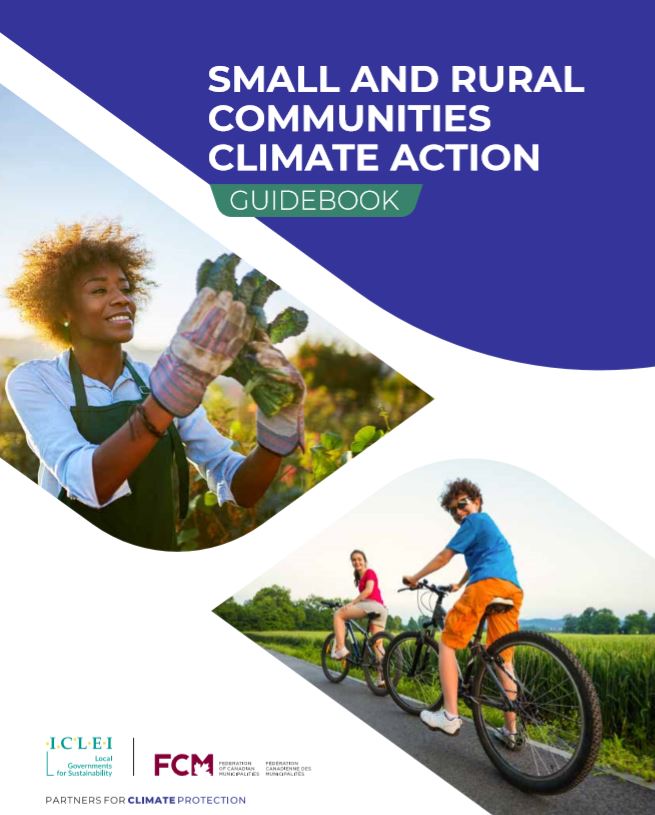
Making up a major portion of Canada’s population, small and rural communities are in the unique position of being able to make significant contributions to national, provincial and territorial greenhouse gas (GHG) emissions reduction targets. However, with limited financial and staffing resources, small and rural communities can face unique challenges when developing, implementing and delivering climate initiatives. Also, much of the conversation around local climate planning centers on the urban experience, leaving small and rural communities with few guides or tools to help them reduce emissions.
The Small and Rural Communities Climate Action Guidebook, developed by ICLEI Canada and the Federation of Canada Municipalities (FCM) for the Partners for Climate Protection (PCP) program, is a direct response to the climate planning challenges faced by small and rural communities, offering local decision makers case studies and advice tailored to their experience.
Designed for municipal staff and decision makers in small and rural communities tasked with developing local climate initiatives or reducing GHG emissions, the guidebook can help municipalities:
- Develop realistic climate action policies
- Engage and collaborate with the public
- Build a GHG inventory baseline and data library
- Generate municipal revenue and local economic and wellbeing benefits through climate action
- Identify sector-specific climate challenges and identify solutions to overcome them
The Partners for Climate Protection program is a partnership between ICLEI – Local Governments for Sustainability and the Federation of Canadian Municipalities.
Natural Asset Management Roadmap Program – Applications Now Open
The Natural Assets Initiative is now accepting expressions of interest from Canadian local governments for the Natural Asset Management Roadmap program, proudly sponsored by Intact Public Entities (IPE).
First developed and offered by NAI through the Federation of Canadian Municipalities’ Municipal Asset Management Program, the Roadmap Program is designed for local governments that are just beginning to incorporate natural asset management (NAM) in their asset management and financial planning. With NAI’s guidance and expertise, this program is an opportunity for local governments to recognize, account for, and ultimately manage natural assets — such as wetlands, forests, and rivers — as a part of their community’s critical infrastructure.
What is a Roadmap?
A roadmap is a good first step for a local government to get a handle on how to manage and value their natural assets. The roadmap is a high-level plan that pulls together individuals from various municipal departments to discuss and centralize their expertise.
Roadmaps have proven to be a relatively low effort, high impact activity requiring no more than a few days’ work for the project lead and a few hours from the other staff participants, yet it provides a strong foundation for participants to get started in NAM with confidence.
In Ontario, municipalities are required to have an approved asset management plan for all municipal infrastructure assets — including green infrastructure assets — that identifies current levels of service and the cost of maintaining those levels of service under O. Reg. 588/17, Asset Management Planning for Municipal Infrastructure by July 1, 2024. The Natural Asset Management Roadmap Program is a great tool to help municipalities ensure they are meeting the proper criteria.
Most local governments complete their roadmap within four months, through which time they are able to:
- Build awareness about NAM among a cross-functional staff group
- Understand how their local government is considering natural assets in planning and delivering services
- Complete a high-level roadmap that includes the actions they will take over the short to medium term to integrate NAM into their asset management practices
- Learn from their peers and build a network helping to advance NAM
Eligibility
IPE is currently sponsoring their municipal clients in Ontario and Atlantic Canada. All other Canadian local governments may submit their interest to participate at the subsidized rate of $850.
Requirements:
- Minimum of three staff participating per local government
- Local elected officials are welcome to participate
- Very small (>1,000) local governments can include two staff and one elected official
- Participating staff should be cross-functional, ideally including a finance official or senior administrator, public works or engineering staff, and environmental sustainability of planning staff
Please note: Small local governments (with populations under 1,000 people) that collaborate on asset management with neighbouring local governments may apply together to develop a single roadmap.
How to Apply
NAI is currently accepting EOIs with the option to begin the Roadmap Program in late 2023 or early 2024.
We encourage all interested Canadian local governments to apply; however, please note that space is limited and preference will be given to those insured by IPE.
Interested local governments are asked to complete the Expression of Interest form. NAI will contact applicants to confirm availability and participation.
If you have any issues accessing the form, please contact [email protected] with the subject line “NAM Roadmap Program”.
Climate-Ready Infographics
Infographics developed and published by the Intact Centre on Climate Change Adaptation for residents and homeowners on dealing with extreme heat, flooding, wildfire, and working with nature at home.
Federation of Canadian Municipalities: Financing tools for local climate action
“Canadian municipalities are reducing greenhouse gas (GHG) emissions through pilot projects, municipal programs, and more. However, financing these initiatives can be a significant challenge.
Our toolkit explains how your municipality can leverage private and community investors to help you take action on climate change in your community.
You will learn how you can:
- Harness people power through group purchasing and community owned renewable power
- Break the capital barriers with local improvements and energy performance contracts
- Create a funding cycle with green revolving funds and Green bonds
This guide is designed for municipalities completing Milestones 3 and 4 of the Partners for Climate Protection program – a partnership between ICLEI — Local Governments for Sustainability (ICLEI Canada) and FCM – but is applicable for communities of all sizes across Canada.”
Federation of Canadian Municipalities Resource: Integrating equity, diversity and inclusion into municipal climate action
”
Climate change has a disproportionate impact on people experiencing homelessness, low-income residents, racialized minorities and other marginalized communities. In order to address issues of inequality and to ensure a better quality of life for all residents, municipalities must begin to integrate the concepts of equity, diversity and inclusion (EDI) into each stage of their climate action planning.
To help communities across Canada better understand and employ these concepts, the Partners for Climate Protection (PCP) program, from ICLEI Canada and the Federation of Canadian Municipalities (FCM), has developed the Integrating equity, diversity and inclusion into municipal climate action resource. This introductory resource was created to help your municipality take the first step on their EDI journey. The resource demystifies key concepts, shares case studies and lessons learned, and provides a basic framework for making EDI a core part of your municipality’s everyday climate planning.
Designed for municipal staff tasked with developing local climate initiatives, this resource can help you:
- Learn the definitions of equity, diversity and inclusion
- Understand how EDI considerations fit into municipal climate action
- Identify how to apply EDI concepts to your work with the PCP Milestone Framework
- Collaborate with vulnerable members of the community
- Overcome common challenges and concerns”
Asset Management Resources for Policy and Governance – Federation of Canadian Municipalities
The Federation of Canadian Municipalities has created resources to support municipalities with asset management in the face of climate change impacts.
CLIMAtlantic Adaptation Library
CLIMAtlantic – Atlantic Canada’s climate services hub – has a repository of numerous resources related to climate change adaptation. Searches can be specified by type of climate hazard, type of solution, and more!
Building Municipal Climate Resilience – Blog from the Climate Reality Project Canada
Through the work of their Climate Hub program – hubs of climate action that bring residents, businesses, researchers, and more together in municipalities to measure and advocate for climate action at the municipal level – the Climate Reality Project Canada has released a blog detailing some clear learnings on building municipal resilience in the face of climate change.